1. The Question Everyone’s Asking
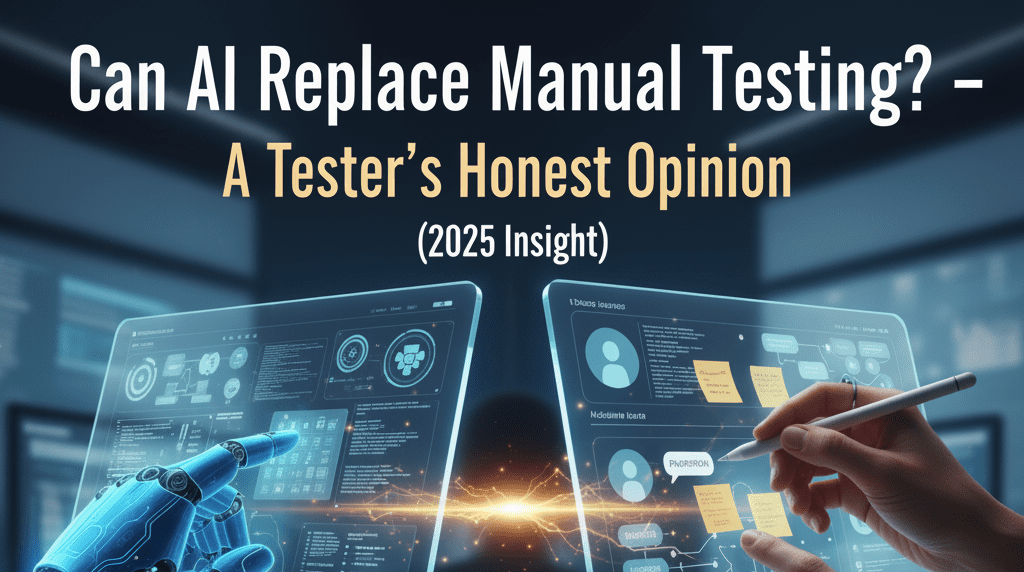
The software world is evolving faster than ever. Every sprint, every deployment, every new update whispers the same question :
Can Artificial Intelligence replace manual testing?
The buzz around AI-powered testing tools, self-healing scripts, and autonomous test bots sounds promising – even intimidating.
But from a tester’s desk, here’s the truth 👇 AI can transform testing – but it cannot replace the human tester.
Let’s decode why.
But from a tester’s desk, here’s the truth 👇 AI can transform testing – but it cannot replace the human tester.
Let’s decode why.
2. What AI Really Brings to the QA Table
AI isn’t just automation with a shiny new label – it’s a smart system that can learn, adapt, and predict.
In the QA universe, AI plays multiple roles:
- Spotting repetitive test patterns faster than a human
- Predicting which modules are likely to fail next
- Prioritizing regression suites intelligently
- Analyzing logs, screenshots, and performance graphs in seconds
It’s like having a data-driven co-tester – incredibly fast, precise, but emotionally neutral Yet, while AI can see patterns, it doesn’t understand purpose – and that’s where real testers step in.
3. Why Manual Testing Still Holds the Core
Manual testing isn’t just about clicking through screens – it’s about thinking, feeling, and understanding like the end user.
Here’s what sets humans apart 👇
- Contextual Thinking – AI can detect that something broke. A human can explain why it matters.
- Human Empathy – Only people can sense frustration, confusion, or delight – emotions that define real UX.
- Exploratory Curiosity – AI follows patterns. Humans break them intentionally – that’s how hidden bugs are found.
- Business Alignment – A tester doesn’t just test code; they test business value, priorities, and user impact.
4. Where AI and Humans Can Join Forces
The smartest QA teams don’t compete with AI – they collaborate with it. Together, they build testing ecosystems that are both automated and empathetic.
| AI Handles | Humans Handle |
|---|---|
| Bulk Data & regression cycles | Exploratory & Creative scenarios |
| Defect clutering & analytics | Usability & accessibility reviews |
| Pattern learning & optimization | Business logic & emotion-driven validation |
This partnership creates a QA process that’s not just efficient, but intelligent and human-centered.
5. A Future Beyond Replacement - Toward Augmentation
The future of QA isn’t AI vs Humans – it’s AI + Humans. We’re entering the era of AI-Augmented Testing, where:Testers become AI mentors, teaching systems real-world logic and user intent. AI becomes a smart assistant, eliminating repetitive work and noise. Testing evolves from execution to experience assurance.By 2030 , the most successful QA professionals won’t compete with AI – They’ll collaborate with it to create flawless digital experiences.
6. A Tester’s Honest Reflection
From my daily QA life, AI feels less like a rival and more like a silent teammate. It’s analytical, fast, and consistent – but lacks instinct, empathy, creativity, and emotion.Testing isn’t just about finding bugs – it’s about understanding people. Until AI can feel curiosity, frustration, or joy, manual testing will remain irreplaceable.
Conclusion
Can AI replace manual testing? No – but it can redefine it.AI is here to handle the volume, not the value. It’s here to empower testers, not erase them.When humans and AI collaborate, testing transforms from a task into an art form — one that delivers not only working software but truly human-centered experiences.
Related Posts
A s a developer with more than two years of experience working on design...
Introduction I n today’s fast-paced digital marketplace, a seamless user experience (UX) is the...

